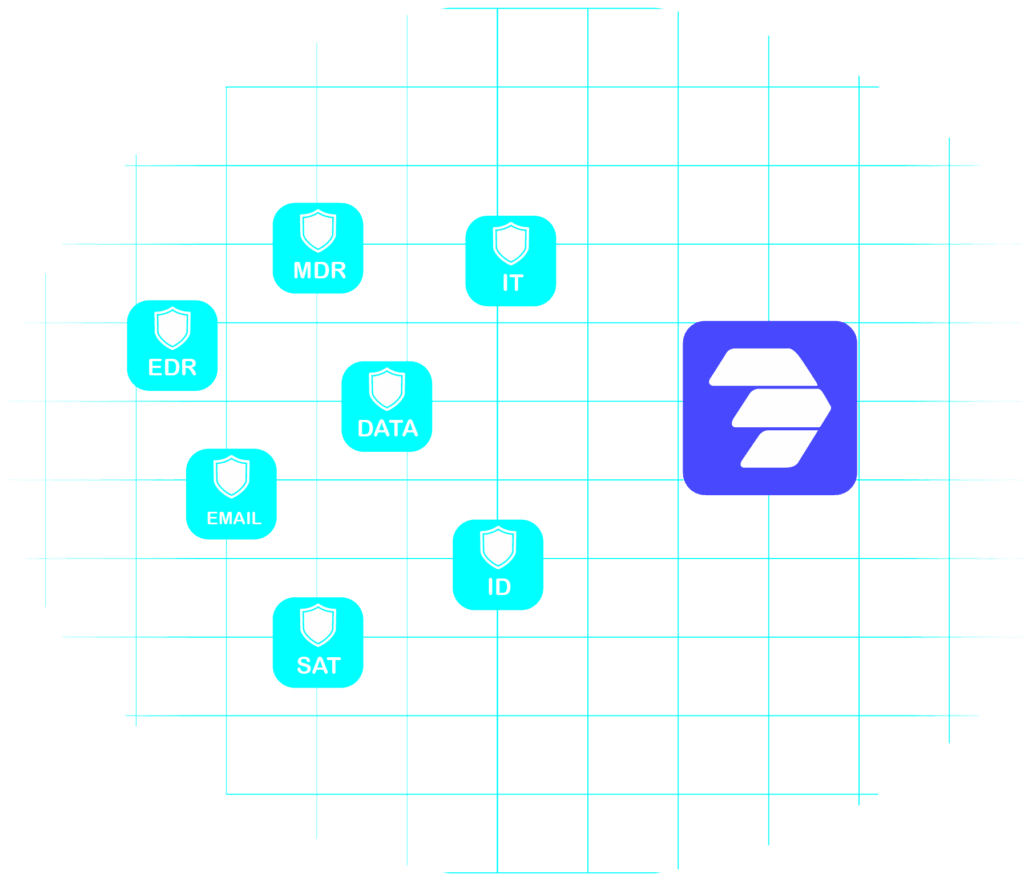
Comprehensive protection for every layer of your business
From each employee's device to your cloud infrastructure, we cover every entry point that an attacker could exploit.
What is the reality of the world of cyberattacks?
Cyberattacks are no longer a possibility—they are a certainty. In 2025, Latin America became the most targeted region in the world, with an average of 3,065 attacks per organization each week—a 26% increase from the previous year. This is the largest increase recorded in any region of the world. Ctrlaltnod
Ransomware is at the forefront of this offensive. Latin America was the region most affected by ransomware globally in 2025, with 8.13% of organizations attacked, while breaches involving stolen credentials continued to rise unabated. Mexico Business News
Europe faces an equally challenging situation. The ENISA 2025 report analyzed nearly 4,900 verified incidents between July 2024 and June 2025 and confirmed that ransomware remains the most damaging threat within the European Union, with phishing as the primary entry point, accounting for 60% of incidents. SecurityAffairsCyble
Spain, Germany, Italy, and France are among the hardest-hit countries, along with Mexico, Brazil, and Argentina on the other side of the Atlantic.
The question is no longer whether your company will be attacked, but when. We'll make sure you're prepared.
|
Cape |
Service |
What It Protects |
Threats It Stops |
|---|---|---|---|
|
1 |
Laptops, desktops, servers |
Malware, ransomware, fileless attacks | |
|
2 |
Corporate email (M365/Google) |
Phishing, identity theft, malicious files | |
|
3 |
User Accounts and Access |
Credential theft, unauthorized access | |
|
4 |
User Accounts and Access |
Malicious websites, dangerous downloads | |
|
5 |
Employee Web Browsing |
Employee errors, social engineering | |
|
6 |
User Behavior |
Data breach, internal sabotage | |
|
7 |
Network Security / SASE |
Connectivity and Remote Access |
Vulnerable VPNs, Access from Insecure Networks |
Why do you need all those layers?
Cyberattacks are not isolated events—they are chains. An attacker does not choose a single path; instead, they combine techniques, look for the weakest link, and escalate from there. Here’s how a real attack works, step by step:
The Hook
An employee receives an email that appears to be legitimate from a known supplier. The email contains a link or an attachment. This is where the email filtering layer should detect and block the phishing attempt before it reaches the inbox.
The Click
If the email gets through, the employee clicks on it. This means that the awareness and training measures failed—the user did not recognize the warning signs. A phishing simulation program combined with ongoing, relevant, AI-based training drastically reduces this risk.
The Infection
When the user clicks on it, malware is downloaded and executed on the employee's device. The endpoint protection layer is responsible for detecting this anomalous behavior, isolating the device, and neutralizing the threat before it spreads, thereby ensuring the system's security.
's Credentials Stolen
If the malware runs, the attacker captures the user's credentials—passwords, access tokens, and session cookies. The identity management layer, with its multi-factor authentication and conditional access policies, is what prevents those stolen credentials from being put to any use.
The lateral movement
Using valid credentials, the attacker attempts to gain access to internal systems, databases, and critical applications. The cloud and application security layer detects unusual access attempts, enforces segmentation, limits what a compromised user can access, and can even block the user.
r Extraction
The ultimate goal is to extract data—customer information, intellectual property, financial data. The data and communications protection layer monitors outbound traffic and blocks unauthorized transfers before the information leaves your network.
That's why you need to be protected!
Attackers don't stick to a single approach. They combine techniques: they send a phishing email (Layer 2), the employee clicks on it (Layer 5 failed), malware runs on their laptop (Layer 1), the attacker steals credentials (Layer 3), gains access to internal systems (Layer 7), and extracts data (Layer 4 blocks communication). Every missing layer is an open door.